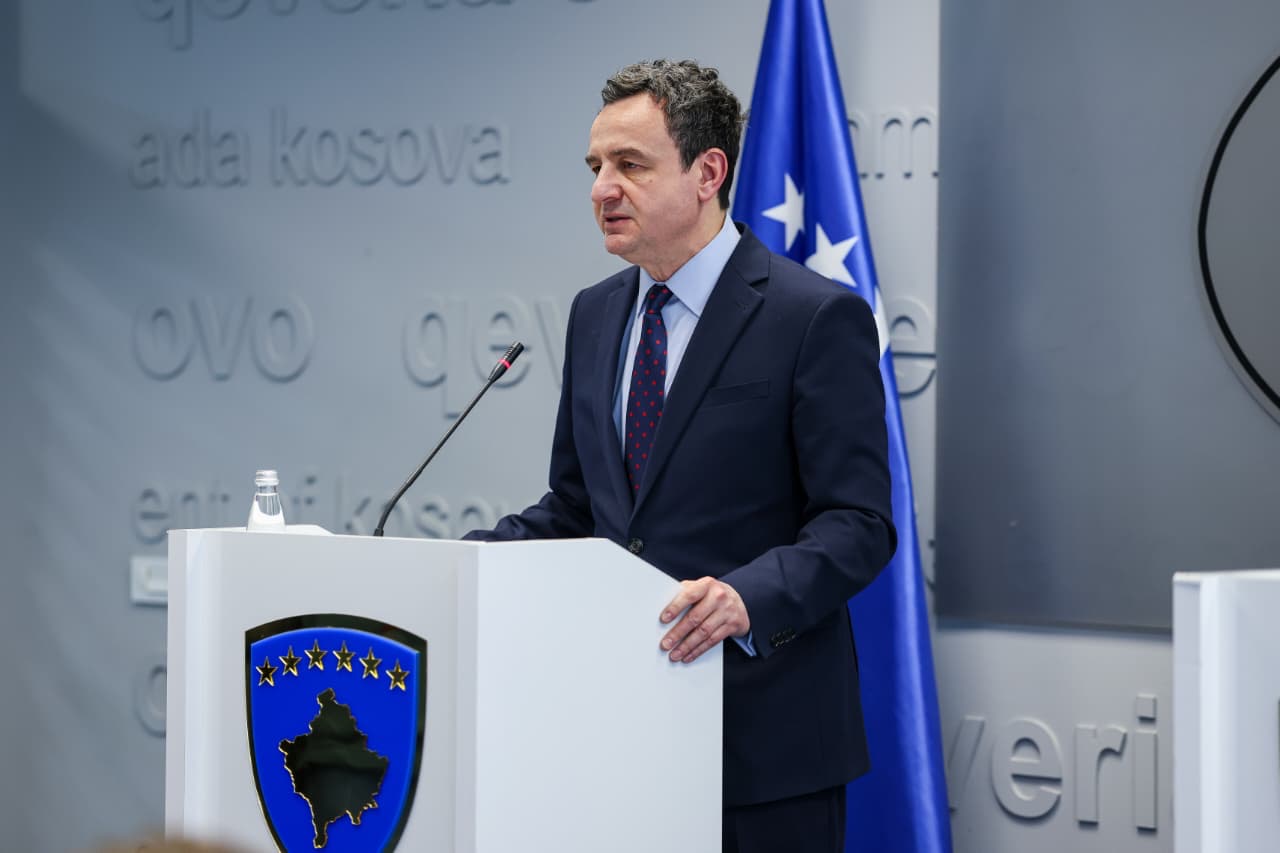
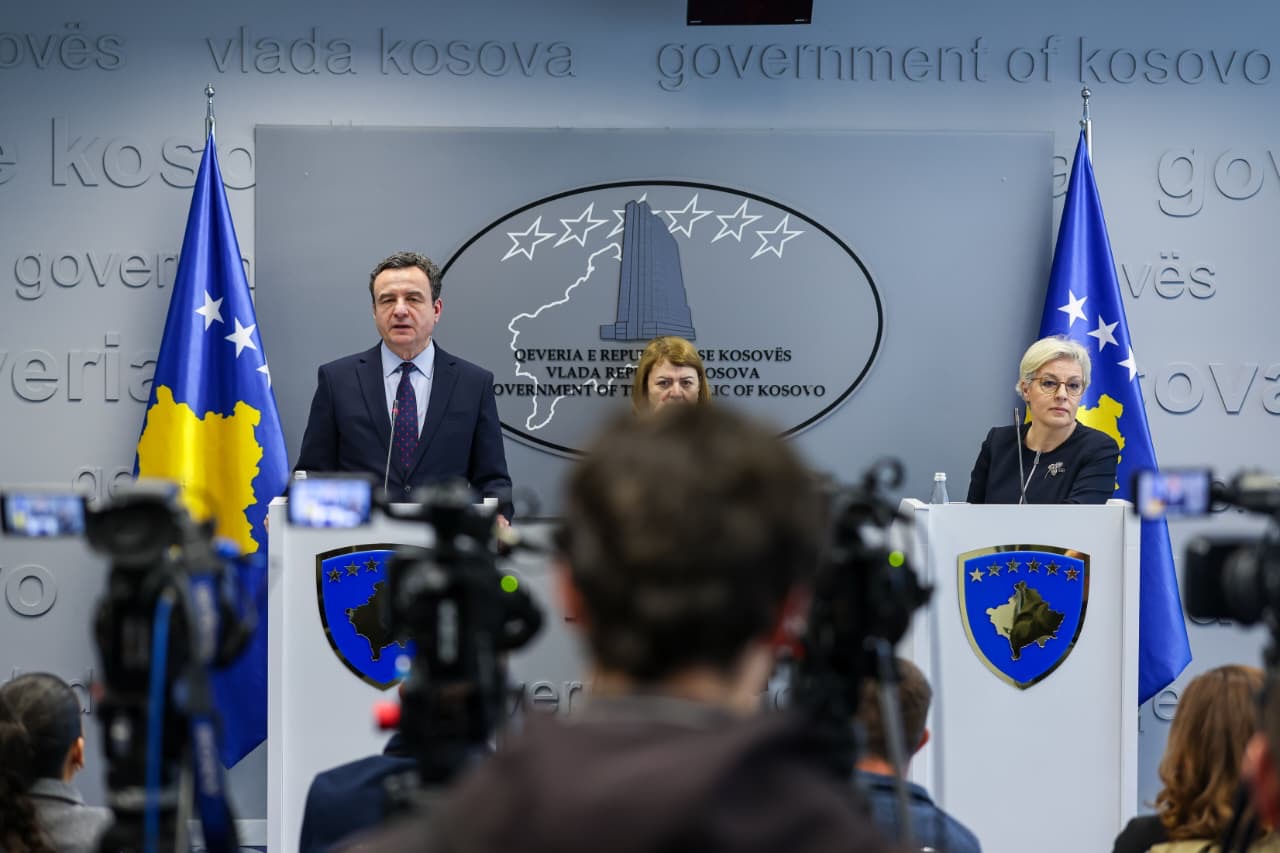
Full speech of the Deputy Prime Minister and Minister of Justice, Donika Gërvalla, at the conference following the 7th meeting of the Government
Prishtina,
30/03/2026
Honorable representatives of the media,
Dear citizens of the Republic of Kosovo,
Today we voted, as the Prime Minister emphasized, the Draft Law on the State Bureau for the Verification and Confiscation of Unjustified Assets, which in fact constitutes one of the main pillars of the deep reform to which we have committed ourselves in the field of Justice.
This Draft Law, which aims to establish a special mechanism, which is the State Bureau for Verification and Confiscation of Unjustified Assets, which we first approved in the Government in December 2021, i.e. during the first year of the Kurti 2 Government’s mandate.
The Draft Law was preceded by a Concept Document in the related field in April 2021, less than 1 month after taking office as the Government.
Let me take this opportunity to thank the former Minister of Justice, the current Speaker of the Parliament, Ms. Albulena Haxhiu, and her team for the colossal work in this field.
So, such an initiative is not a new one; it is an almost five-year marathon journey, an outcome of a yearslong process as part of reforms to strengthen the rule of law and increase effectiveness in the fight against corruption.
The draft law has already been the subject of three opinions by the Venice Commission and two judgments from the Constitutional Court.
But let’s go back in time a little. Having been approved by the Government in 2021, the draft law was taken to the Assembly and the then Speaker of the Assembly, Mr. Glauk Konjufuca, referred it for an opinion to the Venice Commission due to its importance. This responsible institutional action demonstrations the serious approach of the Republic of Kosovo to strengthening the rule of law and to addressing and harmonizing such an initiative with European standards.
The Venice Commission, in its first Opinion dated June 20, 2022, had confirmed that civil confiscation without a condemnatory criminal judgment is acceptable in principle and in line with European practices, but requested greater clarity in the public purpose of the law, strong guarantees for the independence of the institution, a clear standard of proof and effective protection of fundamental rights.
These recommendations are reflected in the text of the Draft Law. Also, throughout this process, the Draft Law was drafted in close cooperation with international partners, including technical consultations and comparative analyses to ensure that the provisions are enforceable, proportionate and constitutionally protected.
After integrating the recommendations of the Venice Commission, the Law was sent to the Assembly and was adopted by the Assembly on 9 February 2023.
However, it was referred to the Constitutional Court by some opposition MPs and remained there for a year and 5 months until July 2024, and after all this long time, the Constitutional Court overturned it.
But, keep in mind, it was not the concept of civil confiscation– precisely where the strongest criticisms of the law’s opponents were focused that the Court overturned. Rather, it confirmed that civil confiscation is a legitimate tool to protect the public interest, and demanded greater clarity of provisions, proportionality in the intervention and strict respect for the separation of powers.
After the Judgment was delivered, the Draft Law was not drafted from scratch, but the specific provisions for which the Constitutional Court thought it had found inconsistencies were reviewed and corrected.
The main issues addressed include the scope and retroactivity of the law, the need for clarity regarding the time periods within which the State Bureau can verify acquired assets, as well as the composition of the Supervisory Commission, in light of the guarantee and respect for the principle of separation of powers.
Although approved several times, we have to send it back to the Assembly for a vote as a result of the Constitutional Court’s Judgment of 9 January 2026, repealing the law that was approved in the Assembly on January 5, 2024 on procedural grounds.
Therefore, allow me to present once again, in a concise and clear manner, its structure and purpose after all the interventions and revisions that have been made.
– The objectives of this law are clear: The law creates a functional and constitutional mechanism for the verification and confiscation of unjustified assets of public officials. It does not aim to replace criminal proceedings or to create a parallel structure with the Prosecution or the Courts. On the contrary, it builds a civil process fully controlled by the Court where the Bureau has a preparatory and analytical role: it collects, verifies and presents evidence, but does not make decisions on confiscation. The final decision is taken exclusively by the Court with full procedural guarantees and if an unjustified disproportion of assets is found, confiscation is made only by a judicial decision.
– In essence, this law aims to create a sustainable accountability mechanism, addressing cases where the assets of public officials do not match their legal income.
– It places emphasis on financial analysis, the civil standard of proof and the final role of the Court. In this way, a clear balance is built between the public interest in fighting corruption and the obligation to respect fundamental rights and procedural guarantees.
Thank you!
Foto Galeria